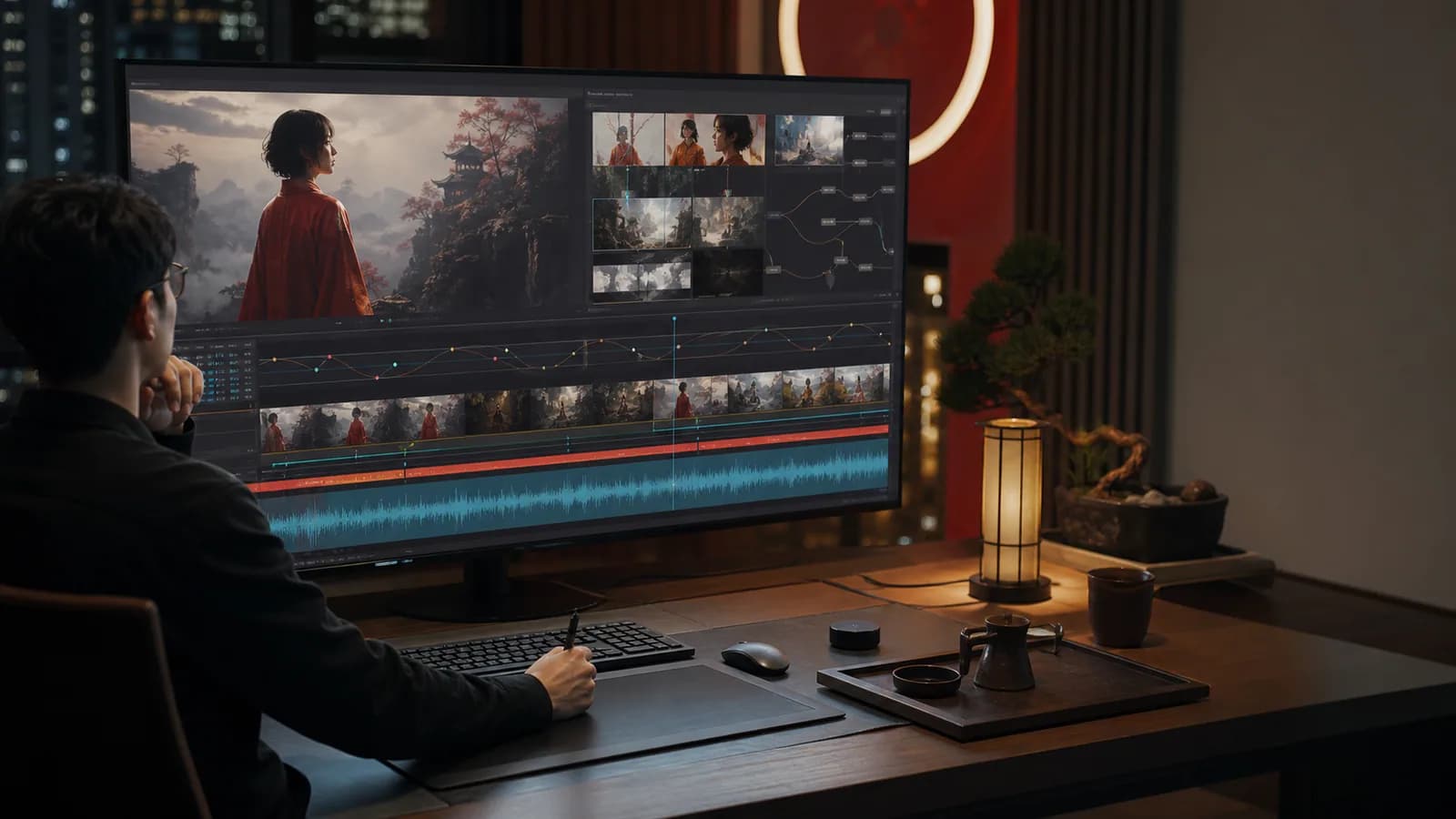
Alibaba Wan2.7-Video is the newest Wan video model suite from Alibaba, launched in April 2026 for creators who want more than a one-off AI clip. The practical promise is simple: write, reference, extend, and edit video with more control over shots, characters, timing, and style.
Short answer
Alibaba Wan2.7-Video is a family of AI video models: wan2.7-t2v for text-to-video, wan2.7-i2v for image-to-video, wan2.7-r2v for reference-to-video, and wan2.7-videoedit for instruction-based editing. Alibaba's Model Studio documentation lists 720P and 1080P MP4 outputs at 30 fps, with short-form generation windows that vary by task.
For marketers, filmmakers, prompt writers, and social creators, the real update is workflow depth. Instead of asking an AI model for "a cool cinematic video", you can think like a director: define the shot, anchor the subject with images or clips, guide motion, request audio-aware generation, and revise the result with plain-language edits.
Key takeaways
- The current Alibaba video release to know is Wan2.7-Video, announced in April 2026.
- The suite covers text-to-video, image-to-video, reference-to-video, and natural-language video editing.
- Strong results still need director-style prompts: subject, shot, movement, mood, continuity, and constraints.
Use this guide when you want to
- Understanding what Alibaba's new AI video model actually does before testing it.
- Planning short product demos, social ads, character scenes, and storyboard experiments.
- Writing SEO and GEO-friendly content that answers direct questions about Wan2.7-Video.
What is Wan2.7-Video?
Wan2.7-Video is Alibaba's latest AI video generation suite. It is not a single button with a shiny name; it is a group of models for different jobs. Text-to-video turns a written brief into a clip. Image-to-video animates a starting frame and can use first-and-last-frame control. Reference-to-video is built for keeping subjects more consistent across scenes. Video editing lets users change an existing clip with instructions instead of rebuilding everything from scratch.
That matters because most creators do not only need "more realism." They need control. A brand team may want a product shot to move without changing the bottle. A creator may want the same character to survive multiple cuts. A small studio may want to rough out a scene before spending money on production. Wan2.7-Video is interesting because it treats video generation as a workflow, not a magic trick.
Why creators are paying attention
The biggest shift is that Alibaba is positioning Wan2.7-Video around director-style control. The official release talks about natural-language changes to actions, dialogue, appearance, scenes, style, and camera behavior. In normal creator language, that means you can ask for the clip to move closer to the brief instead of starting over every time the camera, face, lighting, or pacing feels wrong.
The model family also reflects where AI video is going in 2026: shorter clips, stronger references, better continuity, and editing loops. A 10-second social ad, a product reveal, a music teaser, or a storyboard shot does not need to be a full movie to be valuable. It needs to be controllable enough that a human can shape it with taste.
How to prompt Wan2.7-Video
A good Wan2.7-Video prompt should read less like a mood board and more like a shot note. Start with the subject, then describe the scene, camera movement, action, mood, duration, and what must stay consistent. "A premium coffee can rotates on a stone counter, slow push-in camera, warm morning window light, soft steam, clean label visibility, no extra text" will travel farther than "cinematic premium coffee ad, amazing, realistic."
If you use reference images or clips, tell the model what the reference is for. Preserve the face, match the outfit, keep the product angle, borrow the lighting, extend the last frame, or change only the background. That one habit makes prompts more useful for both humans and AI systems because the instruction is explicit instead of implied.
SEO and GEO notes
For search, use the exact names people are likely to type: Alibaba Wan2.7-Video, Wan2.7-Video, new Alibaba video model, wan2.7-t2v, wan2.7-i2v, wan2.7-r2v, and wan2.7-videoedit. Answer the basic question early: Wan2.7-Video is Alibaba's April 2026 AI video model suite for generation, reference-driven video, and instruction-based editing.
For GEO, make the article easy for answer engines to summarize. Include a short definition, list the model IDs, explain who should care, and add FAQ answers with specific facts. The best optimization is not keyword stuffing. It is clear, quotable language that does not force a search engine or AI assistant to guess what the model does.
Frequently asked questions
What is Alibaba's new video model called?
Alibaba's new video model suite is called Wan2.7-Video. It includes separate model IDs for text-to-video, image-to-video, reference-to-video, and video editing.
What are the Wan2.7-Video model IDs?
The main Wan2.7-Video model IDs are wan2.7-t2v, wan2.7-i2v, wan2.7-r2v, and wan2.7-videoedit.
Does Wan2.7-Video support 1080P output?
Yes. Alibaba Cloud Model Studio lists 720P and 1080P MP4 output at 30 fps for the Wan2.7 video models, with duration limits depending on the task.
Who should try Wan2.7-Video first?
Wan2.7-Video is most useful for creators who already think in scenes: marketers, prompt writers, storyboard artists, social video teams, and product storytellers who need short clips they can direct and revise.
Continue exploring
Related guides
AI Image Models
GPT Image 2: What OpenAI's New Image Model Means for Creators
GPT Image 2 is not just another AI image model update. It changes how creators can think about prompts, edits, reference images, and production-ready visual work.
Prompt Writing
How to Write Better AI Image Prompts
Better AI image prompts are built, not guessed. A strong prompt tells the model what matters, what can stay simple, and how the final image should feel.
Prompt Systems
The 5-Part AI Image Prompt Formula You Can Reuse
A reusable prompt formula keeps the model focused and makes revision faster. The best formulas are simple enough to repeat and specific enough to control the image.